01Vapour Source
Vapour Source
Hydrocarbon vapours originate during dispensing and tank breathing.
MicroVAC is a compact vapour recovery unit designed to capture hydrocarbon vapours generated at retail fuel stations and return recovered hydrocarbons to the underground storage tank.
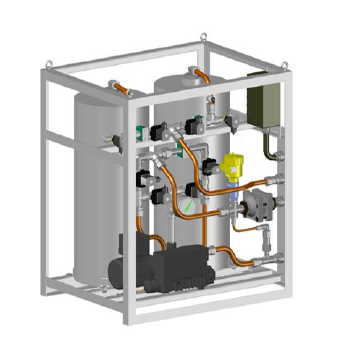
MicroVAC uses adsorption on activated carbon followed by vacuum regeneration to recover hydrocarbon vapours generated during fuel station operation.
Hydrocarbon vapours generated during product transfer and underground storage tank breathing are directed to MicroVAC.
Two activated carbon vessels, V21 and V22, operate in alternating adsorption and regeneration cycles.
A rotary vane vacuum pump regenerates the saturated carbon bed and releases the captured hydrocarbons.
Recovered hydrocarbons are returned to the underground storage tank, where they can be re-absorbed into the liquid product.
MicroVAC combines two activated carbon vessels with vacuum regeneration in a controlled recovery cycle.
A clean engineering visual of the MicroVAC dual-vessel system. Green and blue flow paths show adsorption, regeneration and hydrocarbon return.
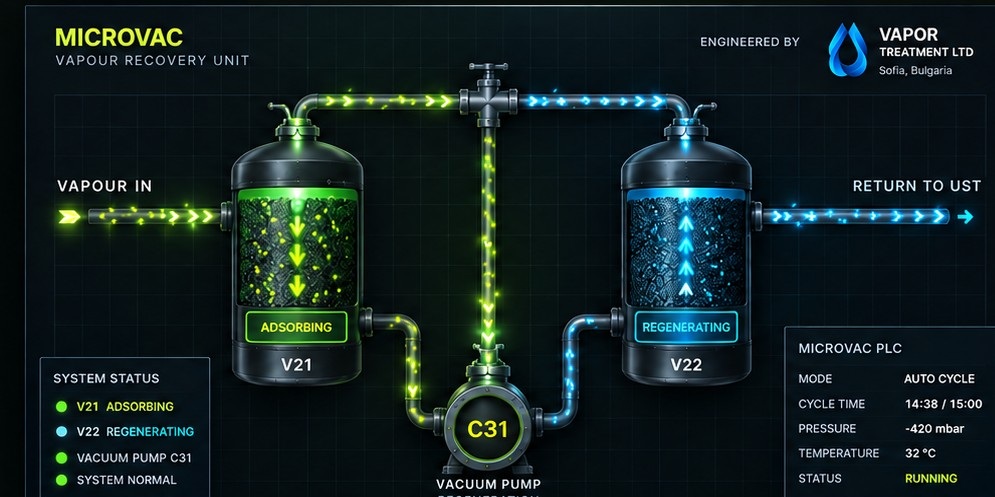
A continuous cycle of adsorption and vacuum regeneration keeps vapour recovery moving.
Hydrocarbon vapours originate during dispensing and tank breathing.
Vapours are directed into the MicroVAC treatment system.
Hydrocarbons are adsorbed by the activated carbon bed.
The vacuum pump regenerates the saturated carbon vessel.
Recovered hydrocarbons are returned toward the underground storage tank.
Recovered hydrocarbons stay in the fuel system instead of being lost.
The MicroVAC system combines two activated carbon beds, vacuum regeneration and automated control in a compact vapour recovery package.
MicroVAC captures hydrocarbon vapours instead of allowing them to escape through the storage tank vent system.
A miniaturized vapour recovery unit designed for installation at retail fuel stations.
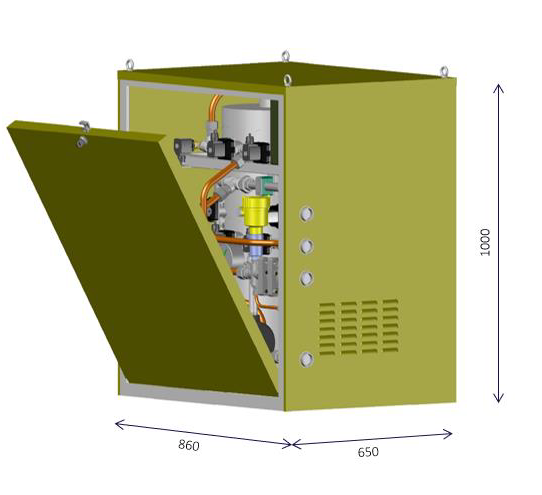
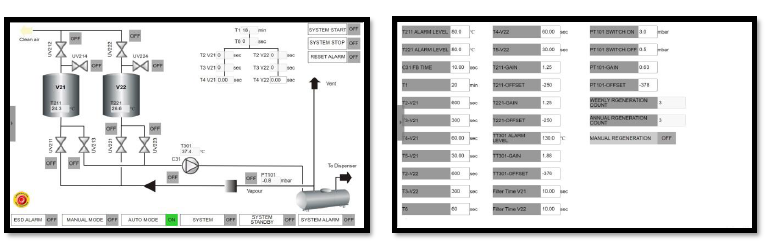
PLC-based control manages the adsorption and regeneration cycles.
Designed to work with Stage I and compatible with Stage II vapour recovery systems.
By recovering hydrocarbons generated during fuel transfer and storage tank breathing, MicroVAC supports cleaner and more efficient fuel distribution operations.
MicroVAC is engineered as a compact vapour recovery solution for retail fuel stations, with published performance parameters for vapour capacity, emissions and ATEX installation.
Technical values shown above are based on the current MicroVAC product documentation. Final equipment configuration and installation requirements should be confirmed for the specific application.
MicroVAC is controlled by a Siemens LOGO PLC. The documented configuration includes a built-in web server, enabling operation from a connected PC, smartphone or tablet.
Use the calculator as an indicative tool to explore the potential value associated with recovered hydrocarbon vapours.
Illustrative vent-loss ranges from the supplied MicroVAC presentation, page 7. These are potential vapour-related losses, not independently verified litres recovered by the equipment. Actual recovery depends on site conditions and equipment performance.
MicroVAC is designed for vapour recovery at retail gas stations, addressing emissions generated during product transfer and underground storage tank breathing.
Vapours generated during fuel transfer can be directed into the recovery system.
MicroVAC can treat vapours associated with pressure changes in the underground tank.
MicroVAC is designed to work with Stage I vapour recovery systems.
The system is compatible with Stage II vapour recovery systems.
Talk to CADABCO about MicroVAC and the vapour recovery requirements of your fuel station application.
Contact CADABCO ENGINEERING LTD for technical information, application discussions and commercial enquiries regarding MicroVAC.